Audio Arts IIIB – Major Project, Semester 2, 2008: Film Sound

As most of you have endeavored to squish your movie down to a civilised file size, I have taken it upon myself to do the same – thanks to some video compression tutoring from the multi-skilled J. Delany. Most of the changes made to this cut have been subtle, such as fine tuning footstep alignment and volume levels. I conceded backing off the sound of running water from the “looking out the window” scene and replaced it with something of a more chilling ambient variety. EQ was applied to various sounds that were a little too stark on their own, and delay was added in the final scene for ‘terror’ enhancing colouration.
As is always the case with such a project, there were things I would change in hindsight, but I think given the timeframe and objectives of the task it has been a success.
Click here to download the movie clip (7.04 MB)
Reference:
Harrald, Luke. “Audio Arts IIIB – Major Project, Semester 2, 2008: Film Sound.” Project undertaken at the Electronic Music Unit, Elder Conservatorium, University of Adelaide, from the 28th of July to the 20th of November 2008.
Labels: Audio Arts IIIB
Audio Arts - Week 11 - Semester 2, 2008, "Student Presentations"
Boo!
Ben:
This succeeded in holding my interest without a single change in instrumentation or a hint of Foley work. My only criticism would be that it did little to evoke genuine fear. However, it did convey the excitement of the chase scene well.
John:
The electric guitars slowed to a deathly crawl were a personal highlight for me. The stark nature of some sounds left me a little cold in places, but then again this is a horror movie.
Jake:
This suitably left of centre approach seems to be coming along nicely. I felt the initial buildup was probably drawn out too long, but this was only a rough edit.
Luke:
Luke talked, audibly but indecipherably, almost the entire time his film was playing which made it difficult to embrace on its own merit. I still like the scream, but I think he shouldn’t get too attached to its ‘raw’ form, and use it in various places with brutal and destructive effects.
? Composition Student:
Interestingly, but perhaps unsurprisingly, this music written on the piano while intended for other instruments produced a weird, incomplete effect. It’s too difficult for me to offer an informed opinion about its intended form from a Sibelius/Kontakt reduction.
Reference:Harrald, Luke. “Audio Arts – Week 11 – Semester 2, 2008: Student Presentations.” Workshop presented at EMU space, level 5 Schultz building, University of Adelaide, 21st of October 2008.
Labels: Audio Arts IIIB
Audio Arts – Week 10 – Semester 2, 2008: “Synopsis of My Project”
 I doesn't look like much work when you put it like this...
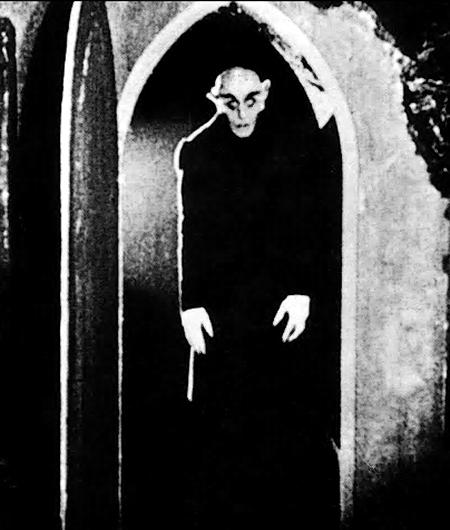
Following Luke’s instruction to embrace and enhance the terror that is Nosferatu, I have taken an approach that works infallibly in all horror movies that adopt it. It can be described as soft, sinister, dark ambience interspersed with brutal transients to let the audience know when there is something onscreen (or about to be) that is truly menacing.
Top achieve this I have used a combination of virtual instruments (orchestral strings, piano and synth pads designed for dark ambience), and specially designed samples. The creepy undertone to Nosferatu entering the man’s room is a sample of my own voice in various breathy forms, heavily processed with an Eventide harmoniser. Other samples have been sourced from various instrument banks, online databases and more personal creations.
I believe I have been successful in creating the ‘heart jolting punches’ that one always receives from a truly suspenseful horror/thriller movie. The more I play with this genre, the more I feel it’s ‘all in the sound’ - horror films would be nothing without rumbling synthesisers, orchestral bass/percussion sections and screeching violins!
One of the most difficult problems I found was with lining up footsteps to onscreen action. There is some choppiness or ‘frame jumping’ in this cut that makes realism hard to perceive on occasion.
Reference:
Harrald, Luke. “Audio Arts – Week 10 – Semester 2, 2008: Synopsis of My Project.” Lecture presented at EMU space, level 5 Schultz building, University of Adelaide, 14th of October 2008.
Labels: Audio Arts IIIB
Audio Arts – Week 9 – Semester 2, 2008 “”

What impressed me most about the Hoth ice battle scene was, despite the corniness (Village Voice criticism duly noted!), Williams’ ability to switch between motifs as dictated by on screen action. To perform this with convincing style is extremely difficult.
I have been meaning to experiment with minor/major inversion tricks for compositional sleight of hand for some time. Clearly the effect of this technique is responsible for the Vader theme’s longevity. Other points of interest in Kalinak’s article were exposing the laborious task of orchestration and the discovery of why so many 1960s movies annoy me. Why cant American business men stick to their own game? This high jacking of film to sell Pop records reminds me of a certain 1950s US songwriter who felt threatened by the self contained juggernaut of Elvis Presley. The said composer put his art on the back burner for a while and (in the traditional entrepreneurial US style of marketing mindless crap to mindless consumers) created some stupid little collector dolls of the King himself. Once these were on the open nick-knack market they apparently outsold Elvis’ ludicrously high record sales in the first year! It seems a fitting story to parallel with a time when the accompanying Pop songs of many pictures “out grossed the films they were composed for.” (Kalinak 1997: 3)
Reference:
Harrald, Luke. “Audio Arts – Week 9 – Semester 2, 2008.” Lecture presented at EMU Space, level 5, Schultz building, University of Adelaide, 7th of October 2008.
Kalinak, Kathryn. “John Williams and ‘The Empire’ Strike Back.” Online article, accessed 9th of October, 2008. URL: http://web.archive.org/web/19970516041818/
http://citd.scar.utoronto.ca/VPAB93/course/readings/kalinak.html
Labels: Audio Arts IIIB
Audio Arts – Week 7 – Semester 2, 2008: “Designing a Movie for Sound”
 George says: "Hmm, It needs more cowbell."
Randy Thom certainly has an agenda with ‘non-sound’ people involved in the film production industry. The article raises many interesting points. It sounds as if directors often don’t know what they want until something arises that they don’t like. From that point it’s likely that the only sure thing is that something else is needed, whatever that may be. For most of us, the few utopian environments that Randy describes in the production worlds of Coppola, Lucas et al, in which all parties know exactly what is going to happen with each medium and where, will unfortunately never be our playground. It seems Randy is pointing out that lack of communication and pre-emptive ideas concerning sound are endemic in all levels of film making. It doesn’t bode well for the aspiring sound artist, who should crave an engaging and collaborative process in which all parties are equally valued and acknowledged from the beginning.
It’s probably best to accept a few shortcomings in this area before one begins a project. At the same time, if one is given the opportunity to meet with a director early in the production process perhaps we need to take the initiative to bombard them with strategic questions – record that conversation it may prove useful in settling later disputes…
Reference:
Harrald, Luke. “Audio Arts – Week 7 – Semester 2, 2008: Designing a Movie for Sound.” Lecture presented at EMU space, level 5, Schultz building, University of Adelaide, 9th of September, 2008.
Labels: Audio Arts IIIB
Audio Arts – Week 6 – Semester 2, 2008: “Foley and Music Presentations”

Jake’s angle on composing for Nosferatu was typically left field and very intriguing. I felt the timing worked particularly well with the break down to Nosferatu’s first appearance. Some work needs to be done on the change of scenes though.
John’s Foley sounded unsurprisingly familiar. It’s kind of weird hearing someone else’s work using the same sound bank and footage. His choices for onscreen action were similar to mine, so hopefully I can rest assured that I’m on the right track. I wasn’t convinced by the music, but along with my own it is an idea in its infancy at this stage.
Luke presented an effective approach to the environment. The only concern may be that the ambience is lending a feeling of tension and impending doom to scene cuts where characters are not necessarily in this mindset, such as the paperwork scene early in Clip 2.
Ben’s ideas seem potentially suitable but need some expansion.
Matt chose to bore us with a theoretical run down of his proposed ideas with no audio to clarify his as yet non-existent results.
Our friend from classical composition’s ideas for a continuous music score (treating the film in the traditional ‘silent’ manner) could raise the bar in terms of expectations regarding the score. Hmm, back to work!
Reference:
Harrald, Luke. “Audio Arts – Week 6 – Semester 2, 2008: Foley and Music Presentations.” Workshop presented at EMU space, level 5 Schultz building, University of Adelaide, 2nd of September 2008.
Labels: Audio Arts IIIB
Audio Arts – Week 4 – Semester 2, 2008: “Foley Part 2”

The collection of sounds created by myself and Mr Delany are already proving invaluable. It’s nice to be working with a pre-defined cut of the film that will not change over time. However, recent outside experience indicates that this is not to be expected.
There is a real art to realising the ambience of a situation in which one would not normally consider the sonic backdrop. Since engaging with film sound I find myself picking at discrepancies in all forms of sound capture and representation. It’s alarming how little attention to detail is evident in many productions, with phasing voice overs sounding like they were recorded in a bathroom and footsteps on a wooden bridge depicting high heels on concrete, to name a couple of recent observations from commercial television.
I have focused mainly on trying to depict the ‘shuffling’ noises of both characters on screen in clip 2. This is easier said than done. While a shuffling noise is not so hard to create, syncing such a noise with perceptually infinite variety to on-screen action is another matter entirely. Next week things should be coming together more coherently.
Reference:
Harrald, Luke. “Audio Arts – Week 4 – Semester 2, 2008: Foley Part 2.” Lecture presented at EMU space and Studio 1, level 5 Schultz building, University of Adelaide, 19th of August 2008.
Labels: Audio Arts IIIB
Audio Arts – Week 3 – Semester 2, 2008: “Foley Creation Part 1”

John Delany and I teamed up for this initial Foley creation exercise. The resulting captures were superior, I believe, to anything I could have manufactured in the same time frame working alone. Below is the basic rundown of asset creation.
Using “Nosferatu” Clip 2, Scene 1:
1.
Scratchy sound of feather writing:
Idea: Record various pens, pencils and other devices writing on paper and other surfaces.
Successful execution.
2.
Scrunching of paper:
Idea: Record scrunching of actual paper or plastic.
Successful execution.
3.
Shuffling of clothes and bag:
Idea: Record various clothing materials / blankets being rubbed together.
Successful execution.
4.
Creaking chair and floorboards:
Idea: Record an old wooden chair or table being pressured to force creaks.
Actual recording was of the EMU space piano stool being pressured to create creaks and squeaks (This was hard work!).
5.
Minor shuffling of feet under table:
Idea: Record some feet or other objects dragging across various surfaces.
Not yet implemented.
Audio will be added here if required...
Reference:
Harrald, Luke. “Audio Arts – Week 3 – Semester 2, 2008: Foley Creation Part 1.” Lecture presented at EMU space, level 5 Schultz building, University of Adelaide,
12th of August 2008.
Labels: Audio Arts IIIB
Audio Arts IIIB – Week 2 – Sonic Analysis of Matrix Lobby Scene:

All this from only five minutes a day - take the abdoflexificationifier six week trial now!!!
Below is my list of sounds and musical effects as they approximately occur in the timeline of the scene.
FX/Foley/Dialogue (Music is included in same list but specifically ID’d):
- Footsteps
- Pile driver (constant rhythmic clunking – could be considered as music)
Music: Rhythmic cymbal
- Crunch of shoe leather
- Clunk of bag
- Whirr of scanning machine
- Beep of machine alarm
- Guard’s footsteps
- Guards voice
- Whoosh of opening jacket
- Guard’s vocal response
- Pile driver stops
Music: Stops
- Thud of hit to guard
- Guard’s cry of pain
- Machine gun fire, ricochets, and squibs
- Guard’s heavy breathing and call for backup
- Retreating footsteps
- Clicking of gun cock
- Machine alarm as Trinity enters
- Trinity’s footsteps
- Trinity’s gun cocked
- Trinity’s machine gunfire
- Pile driver returns
Music: Rhythmic cymbal
- Slow footsteps of Trinity and Neo
- Clack of guns cast aside
- Cock of Neo’s guns
- Many footsteps of entering guards
- Military snare roll
- Shuffling and many gun cocking noises
- Guard: “FREEZE!”
- Brief silence
- Whoosh of N & T ducking for cover
Music: Propellarheads ‘Spybreak’ begins
- Machine gun fire (Lots of) with ricochets, is ever-present from now on unless otherwise indicated.
- Exploding column chunk from bullet
- Many single pistol shots
- Constant sounds of exploding concrete chunks and falling rubble from damage
- Boomier shotgun blasts
- Different machine gun sound introduced to mix
- Trinity: “Hi ya!”
- Thuds from T’s kicks to guard
- Slow motion single shots from Neo’s guns
- Shells tinkling on the floor
- Kick thud and whoosh as trinity takes soldiers gun
- Boom as she shoots him in the back
- More slow motion gun shots from Neo
- Slow motion shots from guards with slow motion explosions also
Music: Cuts temporarily
- Click as Neo grabs a shotgun from the floor
- Whoosh as he flips into another hiding spot
Music: Track resumes
- More slow motion shooting and damage
- More shell tinkling
- Battle noise quiets temporarily (less guards alive to shoot now)
- Guard takes a shot at Neo (machine gun fire)
Music: Musical break (silence)
- Neo takes his turn to shoot at the guard on beat with the music and it resumes accordingly
- Much machine gun fire from Neo
Music: Fast breakdown
- Whoosh as Neo leaps into the air
- Thuds as he kicks the last standing guard in the chest and head
Music: Fades out rapidly
- Thud as Neo lands
- Clacks of gun falling
- Clicking of Trinity’s gun
- Footsteps
- Sliding of feet on floor
- Shuffling of bag
- Clack of dropped shotgun
- Footsteps of both as they move toward elevator
- Click of elevator and button
- Whirr of opening/closing doors
- Click as doors shut
- Ring of elevator bell (oddly placed)
- Reverberation of hall
- Reverberated crash of loose concrete falling to the floor
All sounds are treated with reverberation to give a realistic impression of their place in such a live acoustic environment.
Reference:
Harrald, Luke. “Audio Arts IIIB – Week 2 – Sonic Analysis of Matrix Lobby Scene.” Lecture presented at EMU Space, Level 5 Schultz building, University of Adelaide, 5th of August 2008.
Labels: Audio Arts IIIB
Audio Arts – Week 1 – Semester 2, 2008: Narrative and Sound Points for Nosferatu Clip.
Using clip #2:Below I have given a brief summary of the points in the first three scenes of the clip that I feel are noteworthy of either Foley or accompanying score attention. I chose clip #2 as I feel it has more interesting action to work with.
Scene 1:
- Introduction music to text on screen.
Scene 2:
- Sound of feather writing.
- Shuffling of clothes / hand in pocket.
- Crinkling of paper.
- Shuffling of bag / stuffing in crumpled up paper.
- Semi ominous music to represent buyer’s potentially bad decision.
Scene 3:
- Shuffling in bag.
- Opening of book.
- Sharp scary musical stab to give impact of frightening text content.
- Clock chiming.
- Bag falling on floor.
- Clothes / feet shuffling as man turns to face door.
- Foot steps: inside as man walks toward door and more ominous outside room from Dracula.
- Creak of opening door.
- Screaming strings for image of Dracula.
- Slamming of door.
- Frantic breathing.
- Running footsteps.
- Waterfall / River outside plus howling wind.
- Footsteps as man slowly creeps toward bed.
- Rustling of sheets as he gets in.
- Door creaking then flying open.
- More terrifying music, but not yet at a crescendo.
- Frantic Breathing.
- Sharp turn of head.
- Musical sharp stab at 1st scene of Dracula in doorway.
- Ominous footsteps as he moves closer.
- Music becomes more frantic.
- Rustle of sheet as man puts head under.
- Pause in music as Dracula stops moving.
Reference:
Harrald, Luke. “Audio Arts – Week 1 – Semester 2, 2008.” Lecture presented at the Audio Lab, Level 4, Schultz building, University of Adelaide, 29th of July 2008.
Labels: Audio Arts IIIB